
“Good naked” usually means clean, sexual, or private—
gallery light, bathroom steam, a scene you can pause and frame.
“Bad naked” means ordinary. Practical. Seen—
reaching, twisting, laughing, living.
One gets accepted. The other gets reported.
But the body doesn’t change. Our context does.
Here’s the quiet translation we inherited:
Good = safe. Still. Stylized. Supervised by a lens, a wall, a door.
Bad = unsupervised. Unposed. Unapologetic. Human movement without a chaperone.
We pretend we’re judging skin.
We’re really judging control—how contained the moment feels.
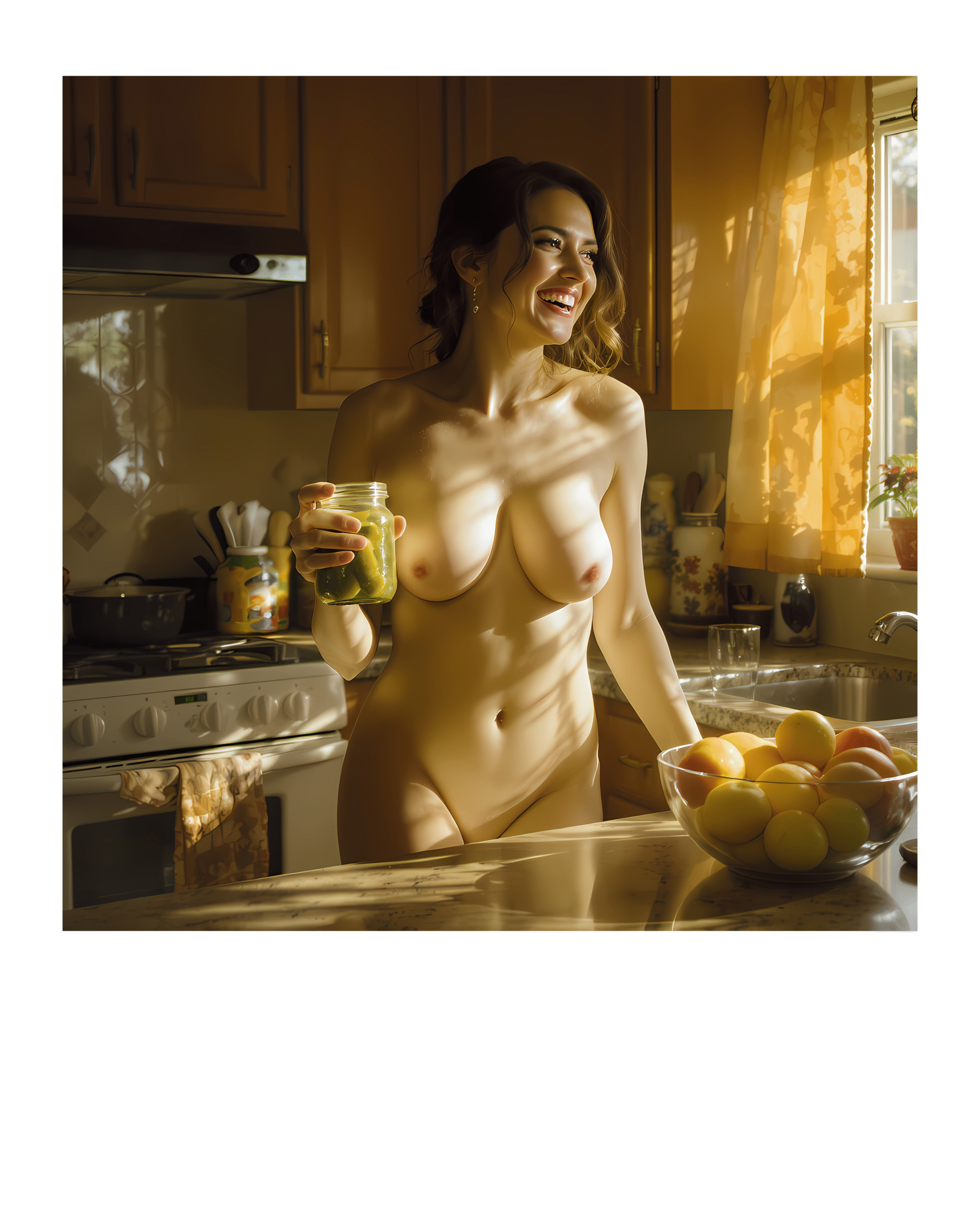
Think of the pickle-jar twist, the mail run, the stretch for the top shelf.
The same curves that look “artistic” at rest become “awkward” in motion.
Not because they are wrong, but because they remind us: bodies aren’t props.
They crease. They jiggle. They exist without asking permission.
So maybe “good naked” isn’t about elegance at all.
Maybe it’s about ethics—three simple questions:
- Was consent given?
- Is the context clear?
- Is respect intact (for the person and the space)?
If those boxes are checked, the body is already good—
in a shower, on a trail, at the mailbox, in a museum.
The rest is choreography we were taught to applaud or punish.
What changes when we stop calling unsupervised humanity “bad”?
We get the same body, finally seen without a performance note—
ordinary, practical, present.
Which is to say: real.